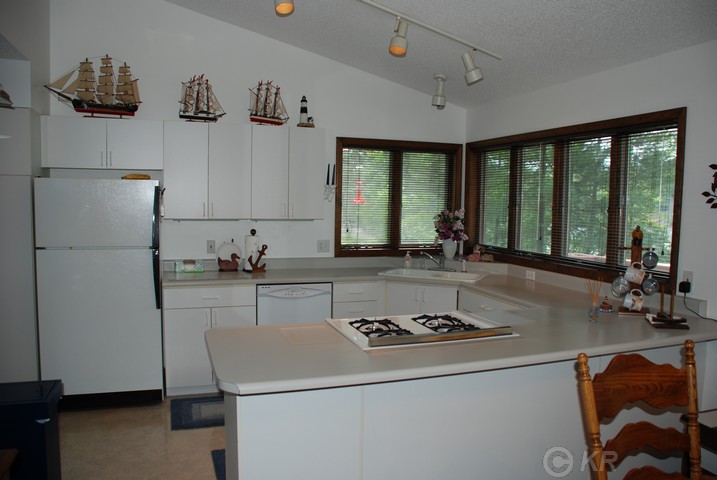
Wednesday, October 23, 2013
1638 Clarwin Road, Gladwin MI - Beautiful Acreage with a Home
Tuesday, October 22, 2013
Eight reasons why it will be harder to get a mortgage in 2014 - Yahoo News
Click here to read the article....
Why Borrowers Pay Different Rates
Lenders, like any business, have to make a profit. The cost of acquiring the funds, the operating costs to service and the expected profit margin are easily identified. The variable in pricing is the type of mortgage and the credit worthiness of the borrower.
A loan with a 3.5% down payment is riskier than a loan with 20% down payment. If the lender has to take the property back to recover their expense, the margin is greater between what is owed and what the property is worth on an 80% mortgage.
Credit scoring is a risk-based pricing method that allows a lender to be competitive in the market for the best loans from different borrower groups. Individual lenders set their own levels for what they consider “A” credit which is reserved for the best rates. If good credit is approximately 710 to 740, scores below that are considered higher risk and will have higher rates.
Risk must be assessed for both the borrower and the property that collateralizes the loan. The borrower’s credit history and income stability are strongly evaluated by the lender but if a default should occur, the property must secure the loan to avoid a loss to the lender.
The challenge for some buyers is they are unaware of what their credit score is and how it will affect the interest rate offered by the lender. It is to the buyer’s advantage to be pre-approved by a reputable lender prior to starting the process of looking for a home. In some cases, the lender can actually improve the borrower’s credit score to help them qualify for a lower interest rate.
Contact me for a recommendation of a trusted mortgage professional - iviebaker@kehoerealty.com
Tuesday, October 15, 2013
Lower Anxieties/Improve Marketability
One of the anxiety highpoints during the sale of a home is waiting for the buyer’s home inspection report. Most sellers willingly disclose what they know about their home to any potential buyers. The concern stems from the inspector finding something that they’re totally unaware of and that it will either cost them a lot of money to correct or the buyer will simply use it to void the contract.
If the inspection does reveal some unknown problem with the home, it’s probably as big a surprise to the buyer who is not as emotionally or financially invested as the seller. It is human nature to fear what you don’t understand and when a report identifies defects, they may simply opt-out of the home.
The solution to the situation may be for the seller to have the home inspected prior to putting it on the market. There is still a risk of becoming surprised by an unknown defect which at that point, would have to be disclosed to potential buyers or repaired by the seller. The advantage is that it creates a baseline to compare discrepancies that may arise when a future buyer has the home inspected.
If the seller’s inspection report is made available during the marketing process, it could give buyers a sense of confidence about the home even though they may still choose to have the home checked by their own inspector.
The cost of the inspection, possibly $500, keeps some sellers from taking this initiative when selling their home. In an effort to minimize their expenses, they forego getting valuable, disinterested 3rd party advice that could help sell their home. On a $175,000 home, the fee for the inspection will probably be less than 3/10 of one percent of the sales price.
Another option to the seller to increase marketability of the property and bolster buyer confidence in the home would be to offer a home protection plan. Generally, the seller doesn’t incur cost for this coverage until the home is sold and there may even be some coverage for the seller during the listing period. The benefit to the buyer is avoiding unanticipated expenses for specific items that are covered during their first year of ownership.
Contact me for recommendations of home inspectors or home protection plans.
Tuesday, October 08, 2013
Rating Your Best Friend
Man’s best friend enjoys many of the benefits of his master’s home besides food and shelter and a comfortable place to live and play. In return, dog owners expect companionship and possibly, protection; after all, even a small dog can bark to signal intruders.
Few people doubt that most dog owners love their pets and treat them well. The costs associated with having a dog can include medical and dental that rivals human expenses, premium food, toys, grooming and license fees. However, one of the expenses not anticipated by pet owners is a higher homeowner’s insurance premium.
There are almost five million dog bites a year with children being the main victims.
“Dog bites accounted for more than one-third of all homeowner’s insurance liability claim dollars paid out in 2012, which amounted to more than $489 million,” said Peter Robertson, representing the Property Casualty Insurers Association of America, testifying against the bill at a hearing of the Committee on Financial Services. He said, “The total cost of dog bite claims increased by more than 51 percent between 2003 and 2012.” It is now estimated that dog bites cause losses of over one billion dollars a year.
Some insurance underwriters have denied or canceled coverage or increased the premium of the owner’s liability insurance based on the homeowners’ specific breed of dog such as Pit Bulls, Dobermans, Akitas, Mastiffs, Malamutes and even German Shepherds. The aggressive nature of certain types of dogs combined with specific training or lack of training, abuse or neglect are identified by insurer’s refusal to provide liability coverage.
If you are considering what insurers identify as a high-risk pet, you might want to visit with your insurance agent prior to acquiring your new best friend to see if it affects your rates.
Tuesday, October 01, 2013
Don't Do It!
You’ve seen lists telling buyers what to do to find the right home but knowing what not to do can be just as important. After finding the right home, negotiating a contract, making a loan application and inspections, buyers, understandably, start making plans to move and put their personal touches on the home.
In today’s tenuous lending environment, little things can derail the process which isn’t over until the papers are signed at settlement and funds distributed to the seller. Verifications are made by a lender at the beginning of the loan process to determine if the buyer qualifies for the mortgage. The verifications are usually done again just prior to the closing to determine if there have been any material changes to the borrower’s credit or income that might disqualify them.
Simply stated:
1. Don’t make any new major purchases that could affect your debt-to-income ratio
2. Don’t apply, co-sign or add any new credit
3. Don’t quit your job or change jobs
4. Don’t change banks
5. Don’t open new credit accounts
6. Don’t close or consolidate credit card accounts without advice from your lender
7. Don’t buy things for your new home until after you close
8. Don’t talk to the seller without your agent
Your real estate professional and lender are working together to get you into your new home. It’s understandable to be excited about one of the biggest decisions you’ll make and that you feel you need to be getting ready for the move.
Planning is smart but don’t do anything that would affect your credit or income while you’re waiting to sign the final papers at settlement.
Tuesday, September 24, 2013
Equity Dynamics
Equity is the difference in what your home is worth and what you owe. Ideally, as the value goes up and the unpaid balance goes down with each amortized payment made, the equity grows from two directions.
This dynamic leads to increasing a person’s net worth much faster than many other investments.
A homeowner has minimal control over value. It is necessary to maintain the property to avoid depreciation and make good decisions on capital improvements. After that, appreciation is generally controlled by supply and demand and the economy.
Mortgage management is something that the homeowner does have control. Making the decision to select a shorter term mortgage at a lower interest rate can have an impact on equity build-up. Lower interest rates amortize faster than higher interest rates which will also affect equity growth. Currently, it is possible to get a 1% lower rate on a 15 year mortgage than a 30 year mortgage.
Compare two alternatives of a 30-year and a 15-year mortgage. The payments will definitely be higher on the shorter term because it pays off quicker. However, if a person can afford the higher payments of $362.53 more per month in this example, the equity will be greater. Even after you take into consideration the higher payments, the increased equity is $17,236 at the end of the seven year holding period.
Another decision that can affect equity build-up is making additional principal contributions along with the regular payments. Whether you’re making an occasional lump sum payment toward principal or regular monthly contributions, it will save interest, build equity and shorten the term on a fixed rate mortgage. Estimate your personal savings with this Equity Accelerator.
Tuesday, September 17, 2013
Who is my agent?
More often than you’d expect, homeowners refer to the person they bought their insurance from as their agent. It sounds reasonable but it’s definitely not accurate. That person is the agent of the insurance company and they legally represent the company, not the customer. Even an independent agent who can place a policy with different companies is still an agent of the company.
A mortgage officer, in most cases is an employee and represents the company. And the same is true for a title or escrow officer. It’s important to understand the actual relationship to know what you can expect from them.
Any business person who wants to stay in business must treat their customers fairly and with a high degree of service. As a customer, you should be able to reasonably expect honesty and accountability. The difference is that employees owe their loyalty to their employer and agents owe their loyalty to their principal.
An agent owes more than just honesty and accountability. The principal can expect complete disclosure, obedience, loyalty, reasonable skill and care and confidentiality from their agent.
This advocacy is very beneficial during the buying or selling process to coordinate all aspects of the transaction. The agent can bring valuable experience to your side of the transaction to provide confidence that your best interests are being represented from start to finish.
Most states have a recognized procedure for the real estate professional to create a formal relationship between themselves and a buyer or seller. This requires a fiduciary/statutory responsibility that places the principals’ interests above the agent’s own personal interests.
Tuesday, September 03, 2013
The Rules
The profit potential in single family homes for investment has been a consistently good long-term investment. They offer investors the opportunity of high loan-to-value mortgages at fixed interest rates for 30 years on appreciating assets, tax advantages and reasonable control that other investments don’t offer.
Last year, Warren Buffett said that if he had a way of buying a couple hundred thousand single-family homes, he would load up on them. Blackstone group L.P. (BX) has now purchased over 30,000 homes and American Homes 4 Rent (AMH) has more than 19,000 for rental purposes.
Individual investors actually have an advantage over the institutional investor but if they are not familiar with rental real estate, some basic rules could be very helpful.
- Invest now to get more in the future.
Whether it is time, effort or money, the prudent investor is willing to forego immediate gratification for something more at a later date. - Real estate is an IDEAL investment.
IDEAL is an acronym that stands for income, depreciation, equity build-up, appreciation and leverage. - Invest in single family homes in predominantly owner-occupied neighborhoods at or below average price range.
This strategy should involve homes that will increase in value, rent well and appeal to an owner-occupant in the future who will pay a higher price than an investor. - Location, location, location.
The same homes in different areas will not behave the same. You can improve the condition, modify the terms or adjust the price but the location can’t be changed. - Understand your strategy – buy and sell, buy and hold or buy, rent and hold.
These three distinct strategies involve big differences in acquisition, management and taxation. - Know where your profit is coming from before you invest.
The four contributors to profit are cash flow, appreciation, amortization and tax savings. They don’t contribute equally or the same in all investments. - Profit starts with purchase.
Buying the property below market value builds profit into the investment initially. - Risk is directly proportionate to the reward involved.
An investment that has a high degree of upside also will have considerable downside possible. - Avoid functional obsolescence unless you have a plan before you buy.
The lack of usefulness or desirability of a home that exists when you buy it will still be there when you sell it. Unless it can be cured, it will affect future profit. - Good property + good tenant + good management = great investment.
These are three solid components for a successful investment. - Problems left unresolved have a tendency to get worse.
It is generally cheaper in time or money to fix a problem earlier rather than later.
If you’d like more information about the opportunities in our market, contact me.
Friday, August 30, 2013
39.65 Square Wooded Acres, Sugar River Road, Gladwin MI - SOLD!
Wednesday, August 28, 2013
3666 Eagleson Road, Gladwin MI - SOLD!
Tuesday, August 27, 2013
Find the "Right" Agent Before the "Right" Home
It’s a common practice for buyers to make a list of what they want in a home during the search process and to explain it to their agent. However, maybe the first list they should make would have the skills they want their agent to have.
The Profile of Home Buyers and Sellers identifies what buyers want most from their agents and as you’d expect, help with finding the right home was ranked highest most often. While it is important, it may not be the most unique of the desired area of expertise.
Equally essential to the success of the transaction are the combination of help with price and terms negotiations and assistance with the paperwork, comparable sales, qualifying and financing.
To summarize the responses in the survey, Buyers want help from their agents with two things: to find the right home and to get it at the right price and terms. Some agents are actually better equipped with tools and acquired knowledge to assist buyers with financial advice and negotiations.
Since an owner’s cost of housing is dependent on the price paid for the home and financing, a real estate professional skilled in these specialized areas can be invaluable in finding the “right” home. An agent’s experience and connections to allied professionals and service providers is irreplaceable.
Ask the agent representing you to specifically list the tools and talent they have to address these areas.
Saturday, July 20, 2013
1664 Cumberland Circle, Gladwin MI - SOLD!
Friday, July 19, 2013
5329 Winchester Way, Gladwin MI - SOLD!
Thursday, July 18, 2013
5641 Lakeside Drive, Gladwin MI - SOLD!
80 or 40 Acres Stockwell Road, Harrison MI SOLD!
Wednesday, July 17, 2013
3729 West Branch Dr, Gladwin MI - SOLD!
Monday, July 15, 2013
Retirement Without a Mortgage
Planning for retirement is obviously important and many times, an activity plagued by procrastination. Some people plan to have their home paid for by that magical date so they won’t have payments after they retire. It makes sense to eliminate a large recurring expense before they quit working.
One strategy would be to be make regular principal contributions in addition to the payments so that it will eliminate the debt by the target retirement date.
Let’s say that a homeowner refinanced their $200,000 mortgage at 4% last year with the first payment due on May 1, 2012. Under normal amortization, the home would be paid for at the end of the term; 30 years in this example.
By making additional principal contributions with each payment, it would accelerate the payoff on the home. An extra $250.00 a month would pay off the mortgage in 10 years. $524.55 extra with each payment would pay off the loan in 15 years; and $796.23 would pay off the loan in 12 years.
Having a home paid for at retirement has the obvious benefit of no house payment. It is also a substantial asset that could be borrowed against or sold if unanticipated events should occur.
Another strategy might involve purchasing a smaller home now to use as a rental that you intend to live when you retire; see Retirement Home Now.
To make some projections to pay off your own mortgage, use this Equity Accelerator.
The Return of the 10 Percent Down Payment - Yahoo! Homes
Remember the 10 percent down payment on a house? After virtually disappearing for years, it's back.
Around the country, some lenders are offering 90 percent financing again on all loan types. For example, San Francisco-based RPM Mortgage resumed offering "piggyback" loans in the first quarter of 2013 after discontinuing them during the height of the credit crisis in late 2007, according to Vice President Julian Hebron. (A piggyback loan enables a home buyer to put only 10 percent down without having to buy mortgage insurance. This is done by getting two loans totaling 90 percent.)
* Click on the Link Above to Real Article...
Tuesday, July 09, 2013
First Person: We're Paying Off Our Home in Half the Time - Yahoo! Homes
My husband and I took out a 30-year mortgage in 2005. Our goal was to pay off our mortgage in half the time. Looking back, it would have been easier to force ourselves into paying our home off early with a 15-year mortgage. However, we are still committed to our goal of paying off our home in half the time.
Read more by clicking on the above link...
Monday, July 08, 2013
When Rates Go Up
Rising interest rates are great if you are renewing a certificate of deposit but not so much when you’re borrowing money. With interest rates on the rise as well as home prices, housing affordability is a concern for would-be homeowners.
A rough rule of thumb is that a person’s or family’s housing should not exceed 28% of their monthly gross income. While rental rates and home prices have been consistently increasing, mortgage rates have been soaring in the past month. In one week, according to the Freddie Mac Primary Mortgage Market Survey, they jumped by .5%.
This means that people have to pay a larger percentage of their income for housing unless their incomes have been increasing at an equal pace. A $200,000 mortgage would be over $100 more per month if closed in July compared to closing at the interest rates available in January of 2013.
If rates increase by .5% by the time you close on the same size mortgage, payments would increase by almost $60 per month. In order to keep the payments the same, a borrower would have to put an additional $11,000 down to lower the mortgage amount.
Check out how your payment would be affected if interest rates continue to rise.
The National Association of REALTORS® suggests that housing is more affordable now than one year ago. However, with all of the variables in play including inflation that was not addressed in this piece, it is unclear how long conditions will remain “affordable”.
Monday, July 01, 2013
FHA & VA Assumptions
Not many buyers have assumed a mortgage in the past 25 years. Most people think it was because FHA and VA in the late 80’s began to require that buyers qualify for the assumptions. Not having to qualify for a mortgage would certainly benefit certain buyers.
If a homeowner must qualify for an assumption like a new loan, they'll generally choose the mortgage with the lower interest rate. Over the past 25 years, rates have been trending down but it appears that rates have bottomed out and will gradually increase. As they continue to rise, the lower rates on the FHA and VA loans created in the last few years will appeal to buyers even if they do have to qualify for the assumption.
There are significant advantages to assuming one of these government insured mortgages if the current interest rate on a new loan is higher:
1. Mortgage is further into amortization schedule
2. Lower interest rate loans amortize faster than higher interest rate loans
3. Lower closing costs than a new mortgage
4. Easier to qualify than on a new mortgage
5. No appraisal required
FHA assumptions are only allowed as owner-occupied residents. The borrower must meet current FHA guidelines for borrowers. The total debt ratio including house payment to be assumed cannot exceed 41% of borrowers’ monthly gross income.
VA loans are also assumable with buyer qualification. However, in order for the veteran Seller to have their eligibility reinstated, the buyer must also be a veteran with eligibility.
A 1% difference in the current rates and a lower assumable mortgage rate begins to make it very attractive to assume a mortgage. When the differential becomes even greater, assumptions will become more prevalent than they’ve been in over twenty years.
Monday, June 24, 2013
Debt Relief = Income
Many times a homeowner might feel relieved being out from under the obligation of a mortgage they can’t afford even though the property was lost due to foreclosure or short sale. If a lender cancels or forgives debt, a taxpayer must include the cancelled amount in their income for tax purposes depending on the circumstances. The tax significance could be serious.
Congress enacted the Mortgage Relief Act specifically to help homeowners who might be affected in the housing crisis that started approximately in 2007. The Act expired on 12/31/12 but was temporarily extended by Congress until December 31, 2013.
This relief only applies to a taxpayers’ principal residence which does not include second homes and investment property. The maximum amount is limited to $2 million of mortgage debt forgiveness or $1 million if filing separately.
Another provision is that the debt relief is limited to acquisition indebtedness used to buy, build or improve the property. It excludes cash equity loans whether made separately or in a refinance of the original mortgage.
Due to the serious consequences involved in short sales and foreclosures, it is advised that homeowners faced with this possibility should seek expert advice from their legal and tax professionals.